A laser built around your product
We do not sell you a catalogue machine. We take a proven standard base and configure it to your product, your line and your output — then prove it with a sample.
Configured to your part · Throughput matched · Sample proven first.
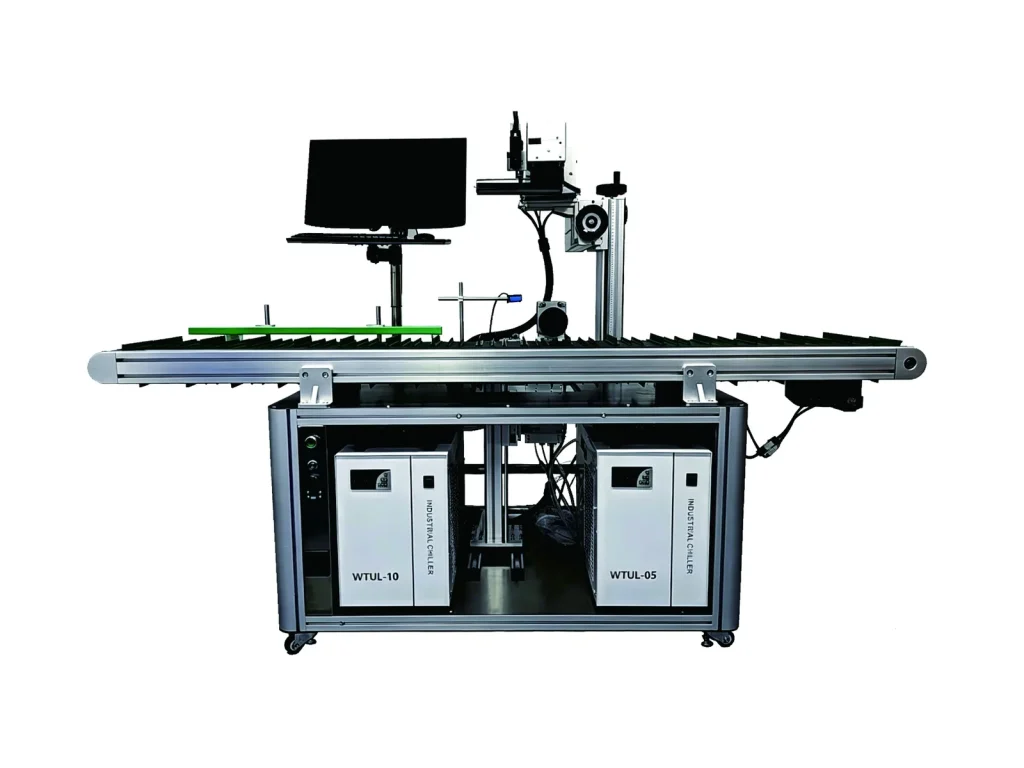 Inline coding on an automated line
Problems we solve on the line
Most factory owners come to us with one of these. If you recognise yours, we already know where to start.
Marking is still manual
Every piece is handled by hand — and your output stops when your people do.
You send it out and wait
Lead times are out of your hands, and someone else keeps part of your margin.
Ink codes rub off
Ink smudges in transit, needs solvents, and you keep buying consumables.
Labels fall off
Adhesive fails in heat, cold or moisture — and traceability goes with it.
The material is difficult
Plastic, glass, coated surfaces or curved parts your current machine cannot mark cleanly.
It cannot keep up
Marking is the bottleneck — or you cannot mark while the product is moving.
Every piece looks different
No two parts match, and rejects cost more than the job pays.
It will not fit your setup
The machine cannot integrate with your conveyor, fixtures or workflow.
Tell us six things and we will spec the machine
You do not need to know which laser you need. Give us these six answers and we will do the matching.
Material
Metal, plastic, glass, coated, packaging or composite.
Product shape
Flat, round, curved, or large and awkward parts.
Static or moving
One at a time on a bench, or inline while the line runs.
Throughput
Pieces per hour, per shift or per day.
What you mark
Date code, batch, barcode, logo, serial number or depth.
Current method
By hand, outsourced, inkjet, labelling — or nothing yet.
The fastest way to a real answer is a sample. We will mark your product and send you the video.
Configured to your job, not to a catalogue
Start from a proven standard base. We change what needs changing.
Laser power
20W / 30W / 50W / 100W, matched to your material and depth.
Working area
110×110 / 200×200 / 300×300 mm, or a custom field.
Rotary axis
For bottles, caps, tubes and other round products.
Fixtures & jigs
Built around your part for fast, repeatable loading.
Line integration
Conveyor, flying marking and auto-feeding where needed.
Fume extraction
Indoor-safe extraction for plastics and coated materials.
Software & programs
Stored recipes for your products, ready for operators.
Voltage & plug
110V / 220V and plug type for your country.
From your product to production
Four steps, starting with the part you already make.
Send your product
Tell us the material, shape and the speed your line runs at.
Sample & spec
We mark your actual product and specify lens, fixtures and integration.
Quote & build
You approve the sample and the spec. We build, calibrate and test the machine before it ships.
Install & train
Delivery, integration with your line, and operator training.
Downtime costs more than the machine
A production machine is only worth what it makes when it is running.
24/7 duty cycle
Configured for continuous production runs.
Spare parts
Critical parts identified and kept ready for your model.
Remote diagnostics
Most issues are diagnosed without a service visit.
Priority response
Production customers are handled first.
Every configured machine starts from a standard base
These are the bases we configure most often for production lines.
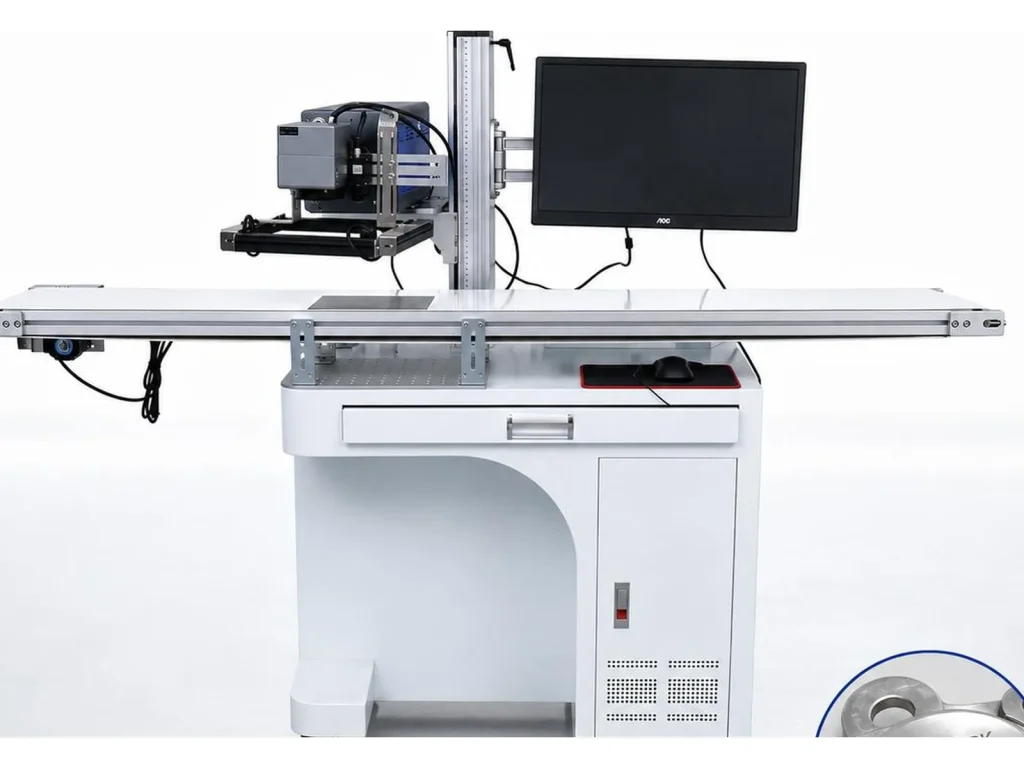
What changes when the laser joins the line
Static cell or flying head
A static cell is right for fixed-position work: the part stops, the fixture locates it, and the mark repeats. A flying head marks while the product moves, which suits packaging, components and parts that cannot stop on the conveyor. Both use the same laser sources — the difference is mounting, sensing and software.
What a production configuration includes
Source and power for the material, working area and focal length for the mark size, the fixture or flying bracket, part sensing and safety, and recipes stored for each product. We prove the mark on your sample before the machine ships, then document the settings so changeover between jobs stays repeatable.
Send the part size, material and line speed through the contact page, or compare the flying laser range for inline work.
What a laser marking production line needs from you
A laser marking production line is specified around the conveyor, not around the laser. We need the line speed, the gap between products, the trigger point and the height available for the marking head. The part has to be held at a repeatable height, and the extraction has to remove fumes without pulling the product out of position. If the line stops and starts, the marking software must handle re-triggers without double-marking.
Send a short video of the line running and the drawing of the product. We will confirm whether a flying laser can mark in motion or whether the part needs a fixture and a stop station, and whether traceability or vision inspection should be added. Industrial laser safety requirements are summarised in laser safety.
Send your product and line speed
We will mark a sample, confirm the configuration and quote the machine with integration and spares.